What is Islam?
The monotheistic Abrahamic religion of Islam was founded in the Arabian Peninsula in the seventh century CE. It is predicated on the lessons found in the Quran, which Muslims consider to be the word of God as it was revealed to the Prophet Muhammad over a roughly 23-year period. Muslims view Muhammad as the last of a series of prophets that includes, among others, Adam, Abraham, Moses, and Jesus.
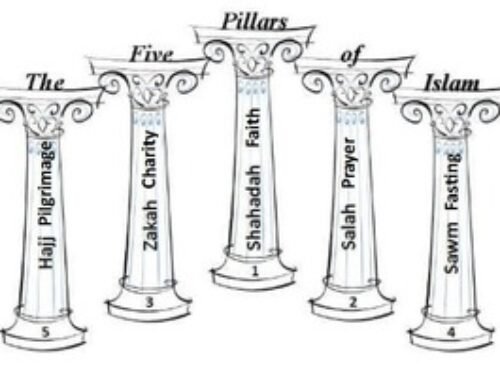
Tawhid, or monotheistic, is the primary tenet of Islam. It affirms the unity and oneness of God, known in Arabic as “Allah”. The Five Pillars of Islam are essential religious observances and activities that Muslims adhere to:
- Shahada: The declaration of faith, affirming that there is no god but Allah, and Muhammad is his messenger.
- Salat: The ritual prayers performed five times a day facing the Kaaba in Mecca.
- Zakat: Almsgiving or charity, where Muslims donate a portion of their wealth to those in need.
- Sawm: Fasting during the month of Ramadan from dawn to sunset.
- Hajj: The pilgrimage to Mecca that Muslims are required to undertake at least once in their lifetime if physically and financially able.
Apart from these pillars, Islam encompasses a comprehensive moral and ethical code guiding various aspects of life, including social, legal, and personal conduct. It emphasizes principles such as justice, compassion, generosity, humility, and respect for others.
Islam has a wide range of traditions, including several philosophical traditions and ways of interpreting sacred writings. Despite having a common fundamental set of beliefs, this worldwide faith has adherents from a wide range of cultures and races, which adds to its rich diversity in practice and understanding..
History of Islam:
The history of Islam spans over 1,400 years and involves significant events that have shaped the religion and impacted societies worldwide. Here’s an overview of key periods and events:
- Prophet Muhammad and the Early Period (610-632 CE): Islam traces its origins to the revelations received by the Prophet Muhammad in Mecca and Medina. Muhammad began preaching the message of monotheism and social justice, facing opposition from the Quraysh tribe in Mecca. In 622, he migrated (known as the Hijra) to Medina, marking the beginning of the Islamic calendar. Over the next decade, Islam spread in the Arabian Peninsula.
- The Caliphates (632-1258 CE): After Muhammad’s death in 632, his companions, known as the Rashidun Caliphs (Abu Bakr, Umar, Uthman, and Ali), succeeded him as leaders (caliphs) of the Muslim community. This period witnessed the expansion of Islam into territories outside Arabia. The Umayyad Caliphate (661-750) and Abbasid Caliphate (750-1258) later succeeded the Rashidun, each contributing to the spread of Islam and advancements in various fields such as science, philosophy, and art.
- Islamic Golden Age (8th to 14th centuries): The Abbasid era is often considered the Islamic Golden Age. This period saw remarkable achievements in science, mathematics, medicine, philosophy, and architecture. Scholars from diverse backgrounds contributed to advancements in knowledge, preserving and translating ancient texts from various civilizations.
- Fragmentation and Empires (11th to 19th centuries): Over time, the Islamic world fragmented into various empires and dynasties, including the Ottoman Empire, Safavid Empire, Mughal Empire, and others. These empires had significant cultural, economic, and political influence in their respective regions.
- Colonialism and Modern Era (19th to 20th centuries): Many predominantly Muslim regions fell under European colonial rule in the 19th and 20th centuries, leading to significant political and social changes. Movements for independence and nationalism emerged across the Muslim world.
- Contemporary Era: The 20th and 21st centuries have seen the emergence of diverse Islamic movements, the establishment of nation-states in the Middle East and North Africa, oil-driven economic changes, and geopolitical shifts impacting Muslim-majority countries. Issues like religious reform, social change, and the relationship between Islam and modernity continue to shape contemporary Islamic thought and societies.
Throughout history, Islam has had a profound impact on art, science, governance, and culture, influencing a wide range of civilizations and leaving a lasting legacy on the global stage.
Islamic Studies is an academic discipline that explores various aspects of Islam, including its history, theology, philosophy, law, culture, and society. It involves the study of the Quran (the holy book of Islam), Hadith (sayings and actions of the Prophet Muhammad), Sharia (Islamic law), Islamic philosophy, theology, literature, art, and the sociocultural impact of Islam on different regions and throughout history.
There are several ways to approach Islamic Studies, such as from a theological, historical, sociological, anthropological, or philosophical standpoint. In this discipline, academics and students study how Islamic philosophy has developed, how Islamic traditions are diverse, how religious scriptures should be interpreted, how Islamic societies have changed over time, and how Islam interacts with other cultures and religions.
This field of study is broad and multidisciplinary, allowing for a comprehensive understanding of Islam and its significance in different contexts around the world. It’s an important area of inquiry for both academic research and for individuals seeking to understand the religion and its influence on societies globally.
History of Islamic study:
The academic study of Islam, known as Islamic Studies, has a rich and diverse history that has evolved over centuries. Its development has been influenced by various factors, including religious scholarship, cultural exchange, and intellectual inquiry. Here’s a general overview:
- Early Period (7th to 12th centuries): Islamic scholarship began during the early centuries of Islam’s expansion. Scholars, known as ulama, engaged in the study of the Quran, Hadith, jurisprudence (fiqh), theology, and other Islamic sciences. This period saw the establishment of centers of learning, such as the House of Wisdom in Baghdad, where scholars translated and preserved ancient Greek, Persian, Indian, and other texts, contributing to the accumulation of knowledge.
- Medieval Period (12th to 16th centuries): Islamic scholarship continued to flourish during this era, with the emergence of renowned scholars like Ibn Sina (Avicenna), Ibn Rushd (Averroes), Al-Ghazali, and others who made significant contributions to philosophy, theology, medicine, and law. Institutions like madrasas (educational institutions) became centers of learning, teaching various disciplines related to Islam.
- Colonial Period and Modernization (19th century): The colonization of many Muslim-majority regions by European powers led to changes in the Muslim world. Western educational systems were introduced, influencing the structure and content of Islamic education. This period also saw the rise of reformist movements aimed at reconciling Islamic teachings with modern knowledge and values.
- Development of Western Academic Study (20th century-present): In Western academia, the study of Islam expanded significantly during the 20th century. Universities established departments and programs dedicated to Islamic Studies, encompassing various disciplines such as history, theology, literature, art, sociology, and politics. Scholars focused on diverse aspects of Islam, engaging in critical analysis, research, and cross-cultural studies.
- Interdisciplinary Approach and Global Perspectives: Islamic Studies today embraces an interdisciplinary approach, examining Islam from multiple angles and contexts. It includes comparative studies of religions, exploration of the diversity within Islam, examination of Islamic law and ethics, and analysis of the sociopolitical dynamics within Muslim-majority societies and in the global context.
The discipline is still developing as a result of new discoveries in academia, societal shifts, and current challenges. It seeks to provide a broader comprehension of Islam’s background, principles, cultural influence, and relationships with different societies over time. Islamic studies continues to be a vibrant and important field of study that advances understanding and communication on a worldwide scale.